Corrosion Testing
Salt Spray Testing —
Accelerated Corrosion Resistance
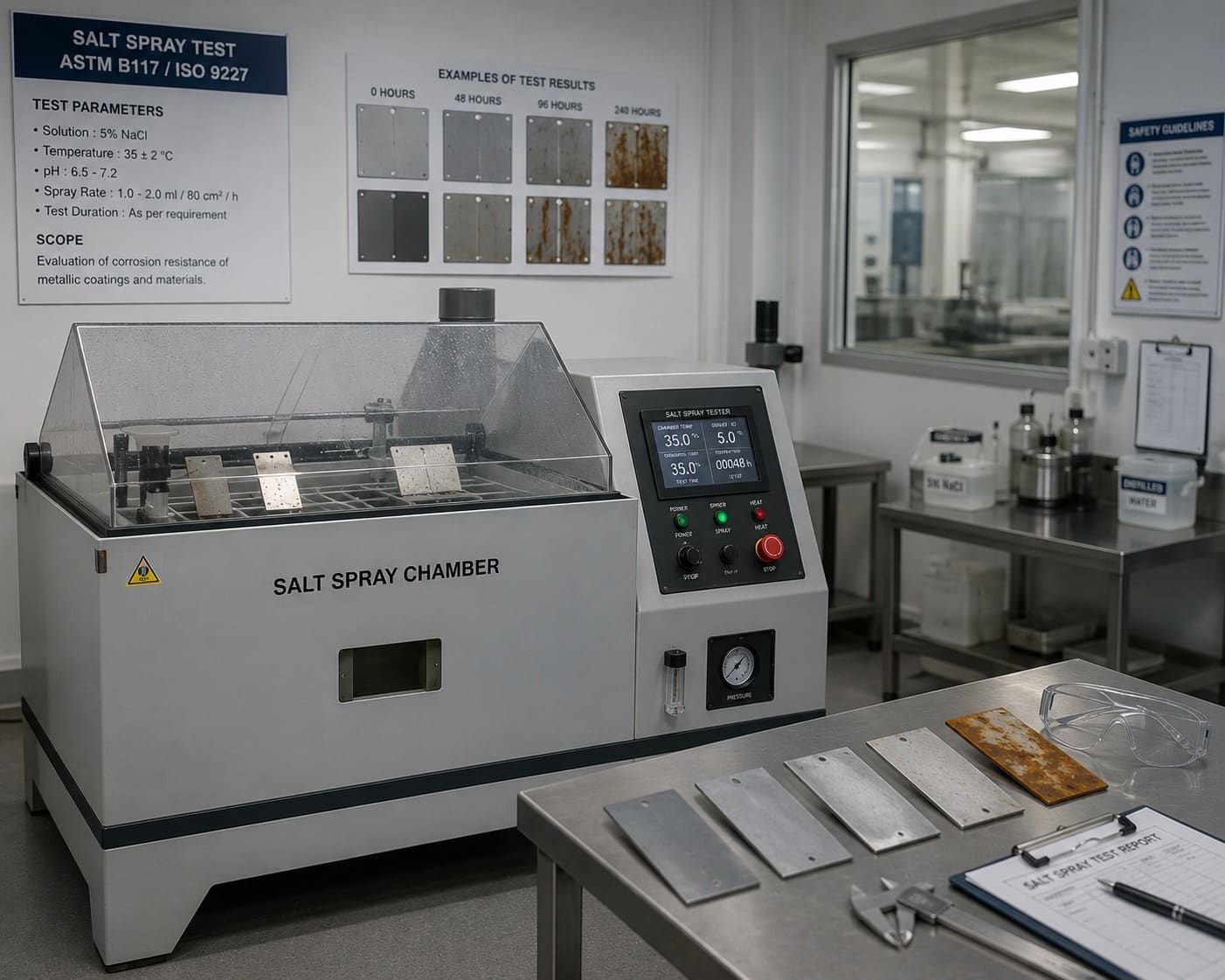
Neutral salt spray (NSS) testing in a controlled 5% NaCl fog chamber. The industry-standard accelerated method for evaluating corrosion protection of coatings, plating, galvanising, and surface treatments.
Request Salt Spray TestingHow Salt Spray Testing Works
Test specimens are placed inside a sealed chamber maintained at 35 ± 2°C. A 5% sodium chloride (NaCl) solution is continuously atomised to create a dense corrosive fog. The fog settles uniformly over the specimens at a controlled collection rate of 1–2 mL/80 cm²/hr. The pH of the collected solution is verified within the 6.5–7.2 range before and during the test.
The elapsed time before the first appearance of corrosion — white rust (zinc corrosion products), red rust (base metal corrosion), blistering, or adhesion loss — is recorded and compared against the specification limit. Post-test visual assessment is conducted per ISO 10289 / ASTM D714 evaluation criteria.
The NSS test is a comparative, accelerated ranking method — not a predictor of real-world service life. It is used consistently across industries to compare and qualify coating systems under reproducible test conditions.
Applications
Fasteners & Hardware
Zinc-plated, hot-dip galvanised, and phosphate-coated bolts, nuts, and hardware per IS 1367, DIN 267, and IS 1573 (minimum hours to first red rust).
Galvanised Steel
Hot-dip and electro-galvanised sheet, section, tube, and pipe. Assessment of zinc coating continuity and adhesion quality.
Painted & Powder-Coated Parts
Automotive body panels, enclosures, and structural components. Evaluated for blistering, rust creep from scribe, and adhesion loss.
Electroplated Components
Zinc, nickel, chrome, and other plated components. Corrosion onset time compared against specification minimum.
Automotive Parts
Suspension, chassis, and body hardware tested per OEM corrosion life requirements.
Supplier Qualification
Side-by-side comparison of coating systems from different suppliers under identical controlled conditions.